
Fuel Control in Agribusiness and Construction: Is It Really Necessary?
Powered by Control IMS LLC
Introduction: two critical industries driven by efficiency
Agribusiness and construction are fundamental pillars of global economic and social development. Beyond job creation and economic impact, these industries are essential for ensuring food supply, infrastructure, and long-term growth.
In this environment, strategies that ensure sustainability, efficiency, and resource control become a competitive advantage. Fuel is one of the most critical resources in both sectors, which leads to an important question: is fuel control in agribusiness and construction really necessary?
Global context: producing more with limited resources
Pressure on agricultural production
According to the Food and Agriculture Organization of the United Nations (FAO), global production reached approximately 1,501 million tons in 2022, only 0.5% lower than in 2021.
This slight decrease, driven by climate change and post-pandemic effects, highlights a key challenge: how to increase productivity despite external constraints.
Efficient management of operational resources, especially fuel, plays a decisive role in meeting this challenge.
Fuel control as an efficiency strategy
Beyond operational control
Fuel control in agribusiness and construction is not just a technical improvement. It is a management strategy that enables companies to:
Reduce operating costs
Prevent fraud and fuel theft
Optimize fleet and equipment usage
Improve decision-making through real data
At Control IMS, we have supported multiple Latin American companies where fuel management was a major operational burden.
When fuel becomes a hidden risk
In many agricultural and construction operations:
Fuel consumption does not match budgets
Control relies on manual processes
Administrative oversight costs are high
Without automation, losses increase and efficiency declines.
Real-world agribusiness case: measurable results
Before fuel control implementation
A sugar production company invested approximately USD 22 million annually in diesel fuel. Fuel supervision was costly, complex, and unreliable.
After implementing fuel control
After deploying Control IMS equipment and services:
Fraud and theft were detected within the first four months
Nearly 30 individuals were removed from the operation
Fuel consumption data became accurate and auditable
Key results
16% reduction in diesel operating costs
Estimated savings of USD 3.52 million
Significant improvement in operational efficiency
This case clearly demonstrates the financial and operational impact of fuel control.
What about the construction industry?
Fuel as a core budget driver
Before the pandemic, the construction sector was projected to grow at approximately 6% of global GDP over 15 years. Although conditions changed, growth expectations remain strong.
However, project success depends heavily on efficient resource management, especially fuel used by heavy machinery and vehicle fleets.
Fuel control to protect schedules and budgets
With more than 12 years of industry experience, Control IMS has proven that:
Automated fuel tracking
Equipment- and project-level traceability
Real-time operational visibility
help construction companies achieve significant cost savings while meeting project deadlines.
How does fuel control work in these industries?
Technology built for demanding environments
A fuel control system integrates:
Tank level sensors
Fuel dispensing controllers
Equipment and operator identification
Monitoring and reporting software
These systems are designed to operate reliably in challenging agricultural and construction environments.
Key benefits of fuel control in agribusiness and construction
Immediate reduction in fuel losses
Stronger administrative control
Reliable data for audits and compliance
Optimized fuel budgets
Improved operational sustainability
Conclusion: fuel control is a strategic necessity
In both agribusiness and construction, fuel control is no longer optional—it is essential.
Organizations seeking efficiency, profitability, and long-term sustainability must adopt automated fuel control solutions.
Fuel becomes a controlled asset rather than an operational risk
🔹 Request a personalized demo
🔹 Talk to an advisor via WhatsApp
🔹 Download our technical PDF of fuel control
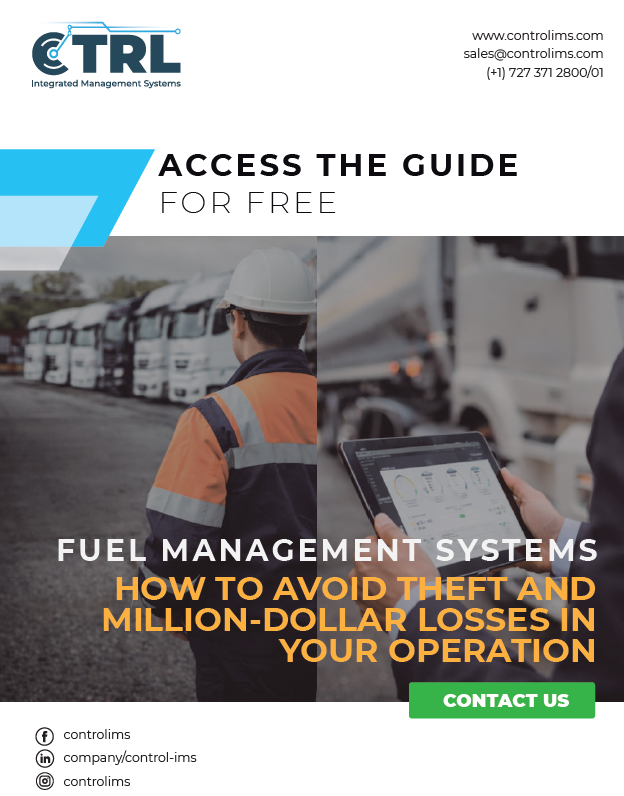
Enhance your operations with cutting-edge technology.
Our expert team is ready to help you achieve greater reliability, efficiency, and safety across every fuel management process. Partner with us today and take your operations to the next level—with measurable results you can trust.
With Control IMS, you’ll always have everything under control.
CONTACT INFORMATION
Office: 12706 59th Way North
Clearwater, Florida 33760
Phone: (+1) 727 371 2800/01
Email: sales@controlims.com
The copyright of the contents of the website belongs to CONTROL IMS LLC.